January 8, 2026
Updated April 8, 2026
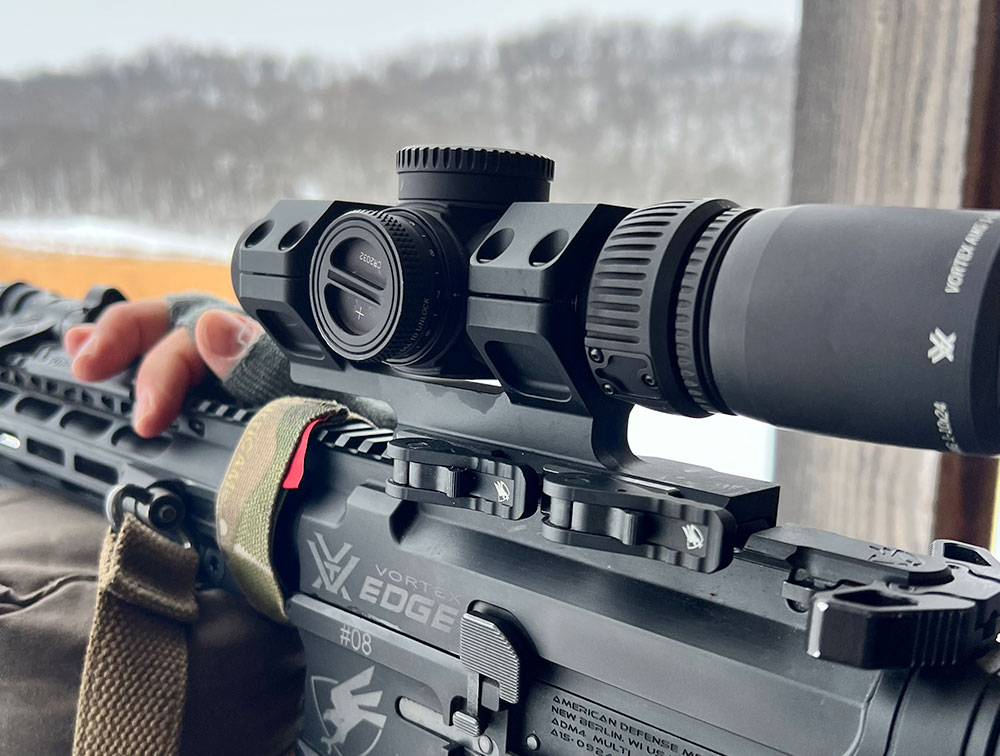
When Ryan Gresham and I rolled into Barneveld, Wisconsin—home turf for Vortex Optics—we weren’t there to casually “check out a new scope.” We were there to put hands and rounds on a piece of glass that’s been whispered about, speculated on, and straight-up ballyhooed: the Vortex AMG 1-10x24 FFP.
And yes—the price tag matches the hype. Vortex lists it at $6,399.99 MSRP. Buy it here.
That number alone sets expectations. Not “pretty good for the money” expectations. Not “duty-grade” expectations. This is “show me the engineering” territory. The good news: Vortex built this optic like it had something to prove.
Vortex doesn’t describe the AMG 1-10 as an incremental upgrade. Their own language is that it was “conceived to meet a standard that didn’t exist”—compact enough for carbines stacked with accessories (thermal, lasers, offset dots, irons), and tough enough to survive what crushed everything else.
That reads like marketing… until you pick it up and realize what they pulled off.
This thing is 8.4 inches long and 18.8 ounces.
In LPVO terms—especially for a true 1-10x—those dimensions aren’t just impressive. They’re borderline disrespectful to physics.
“AMG” in Vortex-world isn’t a random badge. It’s their top-tier build philosophy—engineered, machined, and assembled in the USA (with US and global parts), and held to micron-level tolerances.
That “micron-level” line is the kind of detail you don’t throw around unless your production process can defend it. It also explains why this optic feels more like a precision instrument than a typical LPVO: the mechanical inputs are crisp, repeatable, and built around system integrity, not just feature checklists.
Vortex calls out “patented internals and structural innovations” in the design.
Even without a teardown on the bench, you can feel the intent: reduce wasted space, reduce unnecessary mass, strengthen the system where it matters, and keep the user interface fast under stress.
Let’s talk about what Vortex is clearly aiming at: a hard-use optic that can live on a serious carbine without becoming the biggest, heaviest object on the rifle.
On paper, the field of view is 116 feet at 100 yards on 1x, down to 12 feet at 10x.
That wide view on the bottom end is a huge part of why the scope feels “fast” instead of “scope-y” when you’re running it like a red dot.
This is FFP, so the subtensions scale correctly throughout the zoom range.
FFP in an LPVO can be a love/hate thing depending on reticle design and illumination strategy—Vortex answered that with the EBR-9 (MRAD) reticle and a setup clearly intended to stay usable at both 1x and 10x.
Two features jumped out immediately:
That combo is very “operator-minded” in the best way: solve real problems without requiring you to carry extra gear or do tiny-hands work on a tailgate.
Vortex lists a stack of optical and durability tech that explains why it looks the way it looks:
In plain English: edge clarity, contrast, and color fidelity look “expensive,” and the scope is designed to stay that way after real use.
This is the kind of control layout that makes sense on a working gun: fast, protected, and resistant to getting bumped into the wrong setting.
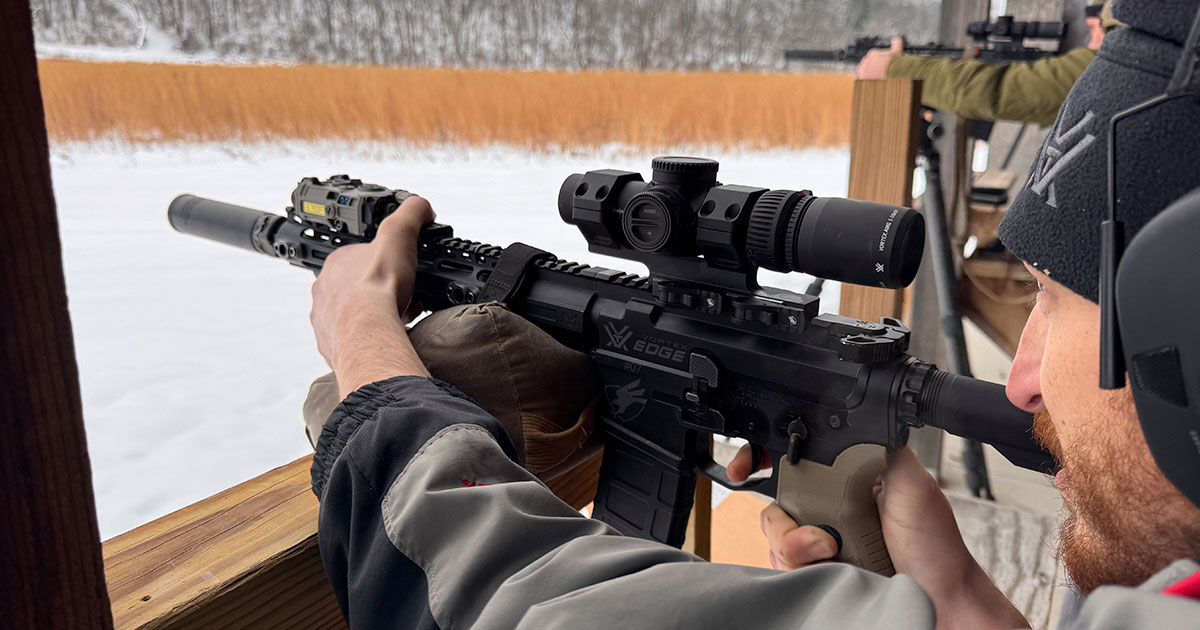
Shooting this optic at Vortex—where the people who build it can watch you run it—adds pressure in a good way. It forces honesty. If something is finicky, you’ll find it. If the eyebox is tight, you’ll feel it in transitions. If illumination doesn’t keep up in daylight, you’ll chase it.
That’s not what happened.
What stood out most was how the AMG 1-10 behaves like two optics that somehow share the same body:
Ryan and I left with the same takeaway: the AMG doesn’t feel like a compromise scope that’s merely “capable” across a range. It feels like it was engineered to be excellent at both ends—while staying shockingly small.
Let’s be blunt: $6,399.99 MSRP is not a casual purchase.
This isn’t aimed at the guy who just bought his first 16-inch AR and wants “a nice scope.”
The AMG 1-10x24 FFP is for shooters who:
And honestly? It’s also for the shooter who’s simply tired of “pretty good” glass and wants the closest thing to a no-excuses LPVO.
Big launches aren’t just about new SKUs—they’re about statements. Vortex already owns mindshare in the LPVO space. But the AMG 1-10x24 FFP feels like a line in the sand: “Here’s what happens when we refuse to accept size and weight as the cost of performance.”
From our trip perspective, it was absolutely one of the highlights—because it’s rare to handle an optic that doesn’t just meet expectations, but resets them.
And when you step back and look at the spec sheet—8.4 inches, 18.8 ounces, true 1-10x, FFP MRAD reticle, dual-zero capped turrets, premium coating stack, US machining/assembly standards—it becomes clear why this optic has been so anticipated.
The AMG 1-10x24 isn’t trying to be the best value.
It’s trying to be the benchmark. ~ KJ
---
Here's the full spec sheet on the AMG 1-10:
Magnification: 1-10xObjective lens diameter: 24mmTube size: 34mmFocal plane: First focal plane (FFP)Reticle: EBR-9 MRAD (illuminated)Length: 8.4 inchesWeight: 18.8 ouncesEye relief: 3.3 inchesField of view at 100 yards: 116 ft. (1x) to 12 ft. (10x)Elevation/windage adjustment: 0.1 MRAD per clickMax elevation travel: 30 MRADMax windage travel: 30 MRADParallax: Fixed at 250 yardsTurrets: Dual-zero capped turrets with toolless adjustmentIllumination: 9 daylight settings, 2 night-vision compatibleBattery: CR2032Lens coatings: Plasma Tech, XR Plus, ApochromaticConstruction: Aircraft-grade aluminum, argon purgedMade in: USA (with U.S. and global parts)Throw lever: Integrated shark fin, ~120-degree rotation from 1x to 10xMSRP: $6,399.99 (street price approximately $3,499–3,999)
Two numbers stand out: 8.4 inches and 18.8 ounces. For a true 1-10x FFP optic with this level of glass quality, those dimensions are borderline absurd. This scope was engineered from the ground up for short-barreled rifles where rail space is at a premium — there's room in front of it for thermals, lasers, offset dots, and backup irons. The 120-degree throw from 1x to 10x is also significantly faster than the 180-degree throw on most competing LPVOs.
The AMG doesn't exist in a vacuum. Here's how it stacks up against the scopes most often mentioned alongside it.
Vortex AMG 1-10 vs. Vortex Razor Gen III 1-10: This is the comparison everyone makes first because they're from the same company. The Razor Gen III is longer (10.1" vs 8.4"), heavier (21.5 oz vs 18.8 oz), and uses a 150-yard fixed parallax vs. the AMG's 250-yard setting. The AMG has a larger exit pupil at 1x (better eyebox), a faster throw lever rotation, and the dual-zero turret system. Optically, the AMG is at minimum on par with the Razor and arguably edges it in edge-to-edge clarity. The AMG costs roughly $1,500 more. If compact size and the dual-zero system matter to your setup, the AMG justifies the premium. If they don't, the Razor Gen III remains one of the best LPVOs on the market at a lower price.
Vortex AMG 1-10 vs. Nightforce NX8 1-8: The NX8 has been a special operations staple for years and is an outstanding optic. It's a 1-8x in a compact package (8.75", 17 oz) at roughly $1,800. The AMG gives you two more magnification powers (1-10 vs 1-8), a more advanced reticle, dual-zero turrets, and superior glass coatings — but at more than double the price. For duty use where the budget allows it, the AMG is the upgrade. For anyone watching the bottom line, the NX8 is still extremely capable.
Vortex AMG 1-10 vs. Kahles K18i 1-8: The Kahles is revered for its glass clarity and is a favorite among competition shooters. At roughly $2,200, it's a phenomenal 1-8x optic. But it's a second focal plane design, and it gives up 2x of magnification range compared to the AMG. Different tools for different jobs — the Kahles is lighter and arguably faster at 1x for pure competition use, while the AMG is built for a harder-use role profile.
Vortex AMG 1-10 vs. Leupold Mark 5HD 1-10: Leupold's entry in the 1-10x space is a solid optic with legendary Leupold glass and a slightly lower price point. However, it's longer and heavier than the AMG, and lacks the dual-zero turret system. Leupold's reputation for customer service and ruggedness is well-earned, but the AMG pushes the engineering envelope further in terms of compactness and features.
For more mid-range LPVO options, check out our best LPVOs under $1,000 roundup.
This optic is not for everyone, and it's not trying to be. Here's who should seriously consider it — and who should look elsewhere.
Buy it if: You're building or running a serious short-barreled carbine and need every inch of rail space. You're a professional end-user or a serious enthusiast who demands the best glass and mechanicals available in an LPVO. You want the dual-zero turret system for switching between suppressed and unsuppressed loads. You've outgrown the Razor Gen III and want the next step up.
Look elsewhere if: You're primarily a hunter who wants a magnified optic for a bolt gun — there are better-suited options for that role at a fraction of the cost. You're building your first AR and want a solid LPVO without breaking the bank — the Vortex Strike Eagle 1-6x or the PST Gen II are outstanding starting points. You don't need the compact size advantage — the Razor Gen III delivers 90% of the AMG's performance at a significantly lower price.
Is the Vortex AMG 1-10 worth the price?
If compact size, top-tier glass, and features like dual-zero turrets are mission-critical for your setup, yes. This optic was designed to meet a military specification that didn't previously exist — compact enough for a fully kitted SBR, tough enough to survive operational abuse, and optically clear enough to shoot precision at 10x. You're paying for that level of engineering. If those requirements don't match your use case, Vortex makes excellent optics at every price point that will serve you well.
What reticle does the Vortex AMG 1-10 use?
The AMG uses the EBR-9 MRAD reticle in the first focal plane. It features a center dot with subtensions for holdovers and wind calls. At 1x, the illuminated center dot functions similarly to a red dot for fast, both-eyes-open shooting. At 10x, the full reticle subtensions become usable for precision engagement. The first focal plane design means the reticle scales correctly with magnification at all power levels.
Vortex AMG vs. Razor — what's the difference?
The AMG is Vortex's top-tier line — engineered, machined, and assembled in the USA to the tightest tolerances in their lineup. The Razor is Vortex's premium line and is also an outstanding optic. The AMG 1-10 is shorter (8.4" vs 10.1"), lighter (18.8 oz vs 21.5 oz), has a larger exit pupil at 1x, a faster throw lever, a 250-yard fixed parallax (vs 150 on the Razor), and dual-zero turrets. The AMG costs more, but the engineering advancements — particularly the compact size without optical compromise — are significant.
What mount does the Vortex AMG 1-10 need?
The AMG uses a 34mm tube, so you'll need a 34mm scope mount. Vortex recommends their own Precision Extended Cantilever Mount, but any quality 34mm mount from Badger Ordnance, Scalarworks, Geissele, or ADM will work. Make sure the mount height positions the optic at a comfortable cheek weld for your stock and shooting style.
Can you use the Vortex AMG for hunting?
You can, but it's not optimized for that role. The fixed 250-yard parallax and the EBR-9 MRAD tactical reticle are designed for carbine and duty use. For a dedicated hunting LPVO, Vortex's Razor LHT or the Leupold VX-6HD would be better-suited choices. That said, if you're running a single rifle for everything and the AMG is already on it, it'll absolutely get the job done in the field.
KJ
Kevin Jarnagin (KJ) hails from Oklahoma but quickly established Louisiana roots after joining the Gun Talk team. KJ grew up as a big game hunter and often finds himself in a different venture often. His early career had him working with one of the finest PR agencies in the outdoor industry – Blue Heron Communications. Before that, KJ molded the minds of business school students at the University of Oklahoma. Quickly learning he had to grow up sometime, KJ dedicated himself to the outdoors no matter what it took.
Sporting his flat-brimmed cap, KJ traverses the country in pursuit of the greatest game and best adventures. Whether it’s making his way to British Columbia for elk or training with pistols, KJ always seems to find a gun in his hands and adventure on his mind. KJ is a skilled communicator and connector in an industry that he has loved since a child.

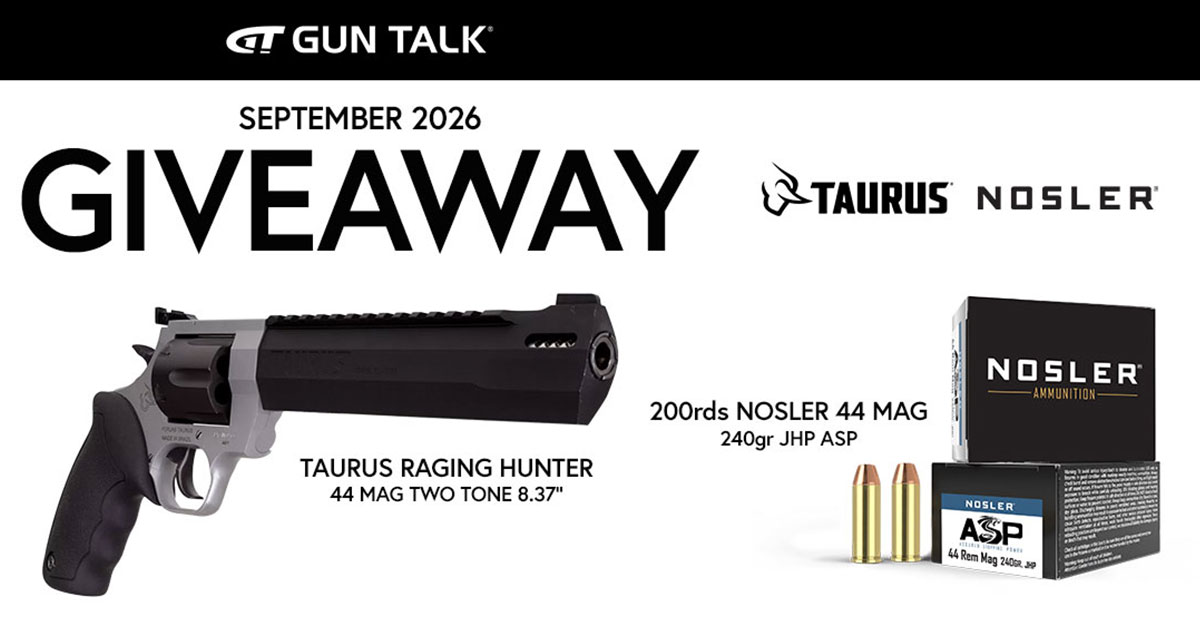
Gun Talk Giveaway
One lucky winner will bring home:
Open to U.S. residents 21+ only. Void where prohibited.