
August 12, 2026
Gun Talk Staff
The National Firearms Act was enacted in 1934. The Supreme Court upheld it in 1937 in Sonzinsky v. United States as a valid exercise of Congress’s taxing power. For 89 years, every court that looked at the NFA said the same thing: Congress can regulate suppressors, short-barreled rifles, and the other NFA categories because collecting taxes on them is a legitimate revenue measure, and the registration apparatus exists to enforce collection of those taxes.
Then Congress zeroed the taxes.
The One Big Beautiful Bill Act, signed July 4, 2025 and effective January 1, 2026, reduced the making and transfer taxes on suppressors, SBRs, SBSs, and AOWs to zero dollars. Machine guns and destructive devices kept their $200 tax. The registration apparatus — the Form 4, the fingerprints, the photographs, the wait, the approval, the federal registry — stayed exactly where it was. You were still waiting months for the government to approve a purchase of something the tax on which was zero.
Silencer Shop Foundation, Gun Owners of America, Palmetto State Armory, SilencerCo, B&T USA, the Firearms Regulatory Accountability Coalition, fifteen pro-gun states, and individual plaintiffs filed suit on August 1, 2025. Their argument: the NFA’s registration requirements were enacted to support tax collection. There is no longer a tax to collect. The constitutional foundation that justified registration has been legislated away. The requirements are therefore unconstitutional.
On August 5, 2026, Judge James Wesley Hendrix of the Northern District of Texas agreed. He wrote a 66-page opinion, entered a permanent injunction against ATF and the DOJ, and then stayed that injunction for seven days to give the government time to seek appellate relief. That seven-day clock expires today.
“The challenged NFA provisions are unconstitutional. Congress enacted those requirements under its taxing power. With the tax at zero, the registration scheme collects nothing and can no longer be justified under any power Congress actually invoked.” — Judge James Wesley Hendrix, Silencer Shop Foundation v. ATF, August 5, 2026
To understand why this ruling matters, you have to understand why the NFA survived for 89 years. The Constitution gives Congress specific, enumerated powers. For most of American history, Congress’ power to regulate firearms was understood primarily through the taxing power — Congress can impose a tax on the manufacture and transfer of certain weapons, and it can require registration to enforce that tax. That’s what the NFA did in 1934. The Supreme Court said so in 1937 and courts have repeated it ever since.
What Congress cannot do — under post-Lopez and Morrison Supreme Court precedent — is retroactively recharacterize a statute under a constitutional power it never invoked. The NFA was a tax law. It was always a tax law. It was never enacted under the Commerce Clause, and the Fifth Circuit’s older dicta suggesting otherwise predate the Supreme Court’s modern limits on the Commerce Clause and are non-binding under the court’s own precedent.
Judge Hendrix’s ruling applies that logic directly: when Congress eliminated the taxes in the One Big Beautiful Bill Act, it removed the constitutional foundation that allowed the NFA to stand. The registration requirements, without a tax to enforce, cannot be justified under the taxing power, the Commerce Clause, or the Necessary and Proper Clause. They are unconstitutional as applied to the untaxed categories. Notably, the plaintiffs abandoned their Second Amendment claims because the enumerated-powers argument gave them everything they needed.
This is a genuinely novel constitutional theory that no court had ever accepted before August 5. It may not be the last word. The Fifth Circuit will have its say. The Supreme Court may ultimately decide. But for now, a federal district court has said what no court has ever said: major portions of the National Firearms Act are unconstitutional.
This is where most of the confusion in social media coverage of this ruling has come from, and it is the section that can mean the difference between exercising your rights and committing a federal felony. Read carefully.
The injunction is party-specific, not nationwide. Judge Hendrix explicitly declined to issue a universal injunction, citing the Supreme Court’s recent decision in Trump v. CASA, which curtails nationwide injunctive relief. The injunction covers specific parties — and only those parties. Everyone else remains subject to the NFA process in full.
| GOA members (current & future) | Gun Owners of America was a named plaintiff. All current and future GOA members are covered. Membership must be active and verified. |
|---|---|
| Other plaintiff org. members | Members of Gun Owners Foundation, the Firearms Regulatory Accountability Coalition, and other named plaintiff organizations are covered. Verify your specific organization’s named-plaintiff status — don’t assume coverage from a general affiliation. |
| Silencer Shop customers | Silencer Shop Foundation is the lead plaintiff. Customers purchasing through the Silencer Shop dealer network for covered items are protected — no Form 4, no registry entry, standard NICS check only. |
| PSA / SilencerCo / B&T / Hot Shots customers | Palmetto State Armory, SilencerCo Weapons Research, B&T USA, and Hot Shots Custom are named commercial plaintiffs. Their customers for covered items are protected. |
| 15 plaintiff states’ agencies | Alaska, Georgia, Idaho, Indiana, Kansas, Louisiana, Montana, North Dakota, Oklahoma, South Carolina, South Dakota, Texas, Utah, West Virginia, and Wyoming. State agencies and subdivisions in these states are covered. Individual residents are not covered solely by residing there. |
| Everyone else | NOT COVERED. The injunction does not apply. Form 4 and Form 1 remain fully in effect. Attempting to transfer or manufacture NFA items without compliance is a federal felony regardless of this ruling. |
The injunction covers the four categories that Congress zeroed the tax on in the One Big Beautiful Bill Act:
The following are NOT covered and remain under full NFA regulation:
Gun Owners of America issued a Notice of Intent to Transfer Items Previously Regulated by the NFA, Pursuant to Judicial Injunction in Silencer Shop Foundation v. ATF. This is the document you’ve been hearing about. Here’s what it actually is.
The Notice of Intent is GOA’s formal communication to its members and to dealers that it is asserting the protections of the injunction on behalf of its members for covered NFA item transfers. It is not a workaround document. It is not a magic form that extends the injunction to non-members. It is a legal notice, from a plaintiff organization to its members, stating that the court order protects them and that GOA intends to enforce those protections.
For a GOA member, this notice is meaningful: it signals that the organization is actively asserting their coverage under the injunction and is prepared to defend that coverage legally if ATF attempts to enforce against a covered member. For a non-member who found the form online and thought it might cover them, it does not. The injunction covers GOA members. Non-members are not covered by GOA’s membership-based coverage, regardless of what documents they present at a dealer.
If you are a GOA member and the stay has expired: your membership in the named plaintiff organization is the source of your coverage. The Notice of Intent is GOA’s formal assertion of that coverage. Dealers will need to work through the practical implementation — the injunction does not provide a checkout procedure, and how FFLs should process these transactions is one of the unresolved practical questions of the ruling.
Today is August 12. The seven-day stay expires today. There are three possible outcomes:
If the government has not obtained a Fifth Circuit stay by the time the district court’s seven-day window closes, the permanent injunction becomes operative. Covered parties — GOA members, Silencer Shop customers, PSA/SilencerCo/B&T/Hot Shots customers — can begin transacting without NFA registration and approval. ATF faces legal exposure for attempting to enforce against covered parties. Practical guidance from ATF on how to process these transfers is expected but has not been issued as of this writing.
The government files for a stay with the Fifth Circuit and it is granted. The injunction is back in suspension. The full NFA process resumes for all parties while the appeal proceeds, which could take 12–24 months. This is the outcome the DOJ is working toward and the one that preserves the status quo while the constitutional question is briefed and decided. It is a realistic possibility, particularly given the magnitude of the ruling.
The Fifth Circuit declines to extend the stay. The injunction remains operative, and the government then faces the prospect of the Fifth Circuit deciding the appeal on the merits while the injunction is actively in effect. This is the scenario that accelerates the practical dismantling of NFA enforcement for covered parties and puts significant pressure on Congress and DOJ to act administratively.
Representative Andrew Clyde (R-GA) and Senator Steve Daines (R-MT) have led 47 Republican lawmakers in sending a letter to the ATF urging the agency to apply Judge Hendrix’s holding as its “nationwide operating position” — effectively using regulatory authority to expand the injunction’s reach beyond the covered parties to all Americans. The letter reads in part: “The DOJ should apply the court’s constitutional holding as its nationwide operating position. The court held that the challenged NFA provisions — governing registration, application, and transfer of untaxed firearms — are unconstitutional because they no longer rest on any valid exercise of an enumerated power.”
GOA’s stated preference is for the DOJ to abandon the appeal entirely rather than seek a stay or fight the ruling. If the DOJ followed the congressional letter’s guidance and applied the ruling nationally through administrative action, the practical effect would approach what a true nationwide injunction would have achieved. Whether the current administration’s DOJ takes that path is a political question that will determine whether this ruling’s benefits reach beyond the covered plaintiffs quickly or slowly.
The concurrent cases in other circuits — Brown v. ATF in the Eastern District of Missouri (filed August 1, 2025) and Roberts v. ATF in the Eastern District of Kentucky — raise the same constitutional theory. Those cases have not yet been decided. If they succeed, coverage extends into the Sixth and Eighth Circuits. The legal geography is the strategy: build circuit-by-circuit precedent toward a conflict that forces Supreme Court resolution.
Let’s be honest about the scale of what happened on August 5. The NFA has been part of American law since 1934. It has never been successfully challenged at the federal appellate level on constitutional grounds. The Second Amendment litigation of the past fifteen years — Heller, McDonald, Bruen, and their progeny — changed the landscape for Second Amendment claims. But those cases were about the right to keep and bear arms, not about whether Congress had the structural power to enact the NFA at all.
This case takes a different path. It doesn’t argue the NFA violates the Second Amendment. It argues that the NFA, as currently structured after the tax reduction, exceeds Congress’s enumerated powers. That argument is not dependent on who the justices are or on how they read the history of armed self-defense. It is a structural constitutional argument about what powers Congress actually exercised when it wrote the NFA in 1934.
If this ruling ultimately survives appellate review — a significant if, but no longer an impossible one — the practical consequences are enormous. Suppressors, SBRs, and SBSs would move off the NFA registry and into the ordinary firearms transfer framework. Form 4 and the approval process would be gone for those categories. The federal suppressor registry would cease to grow. The pipeline of NFA paperwork that ATF has been managing for decades would dry up for the untaxed categories.
That is not what happened on August 5. What happened is that a credible federal judge, in a 66-page opinion, said that outcome is constitutionally required. Whether the appellate courts agree will determine whether this is the first step toward dismantling NFA registration or a well-reasoned district court opinion that the Fifth Circuit ultimately reverses.
What is not in doubt: this is the most significant legal challenge to the NFA since its enactment. We covered the earlier stages of the 2026 NFA transformation — the ATF’s proposed fingerprint simplification rule and the 177% surge in NFA background checks that followed the tax elimination — and this ruling is the logical next chapter in that story. Gun Talk Media will cover every development as it moves through the courts.
| August 1, 2025 | Silencer Shop Foundation, GOA, PSA, SilencerCo, B&T, FRAC, 15 states, and individual plaintiffs file suit in the Northern District of Texas. Consolidated with Jensen v. ATF. |
|---|---|
| January 1, 2026 | One Big Beautiful Bill Act takes effect. Making and transfer taxes on suppressors, SBRs, SBSs, and AOWs reduced to $0. Machine guns and destructive devices keep $200 tax. Full NFA registration process remains in place. |
| August 5, 2026 | Judge James Wesley Hendrix grants summary judgment. 66-page opinion holds NFA registration requirements unconstitutional for untaxed categories. Permanent injunction entered against ATF and DOJ. Seven-day stay entered to allow appellate relief. GOA issues its Notice of Intent the same day. |
| August 5–12 | DOJ debates internally whether to appeal and whether to seek a Fifth Circuit stay. Clyde/Daines congressional letter urges nationwide application. Silencer Shop updates ssf.org with live case status. |
| August 12, 2026 | TODAY. Seven-day stay expires. If no Fifth Circuit extension: injunction becomes operative for covered parties. If Fifth Circuit grants stay: NFA process resumes for all while appeal proceeds. |
| TBD | Fifth Circuit rules on stay and merits of appeal. Timeline: months to potentially over a year. |
| TBD | Brown v. ATF (E.D. Missouri) and Roberts v. ATF (E.D. Kentucky) — parallel cases raising the same theory in the Eighth and Sixth Circuits. |
| TBD | Potential Supreme Court resolution of a circuit split or direct cert grant if the Fifth Circuit rules on the merits. |


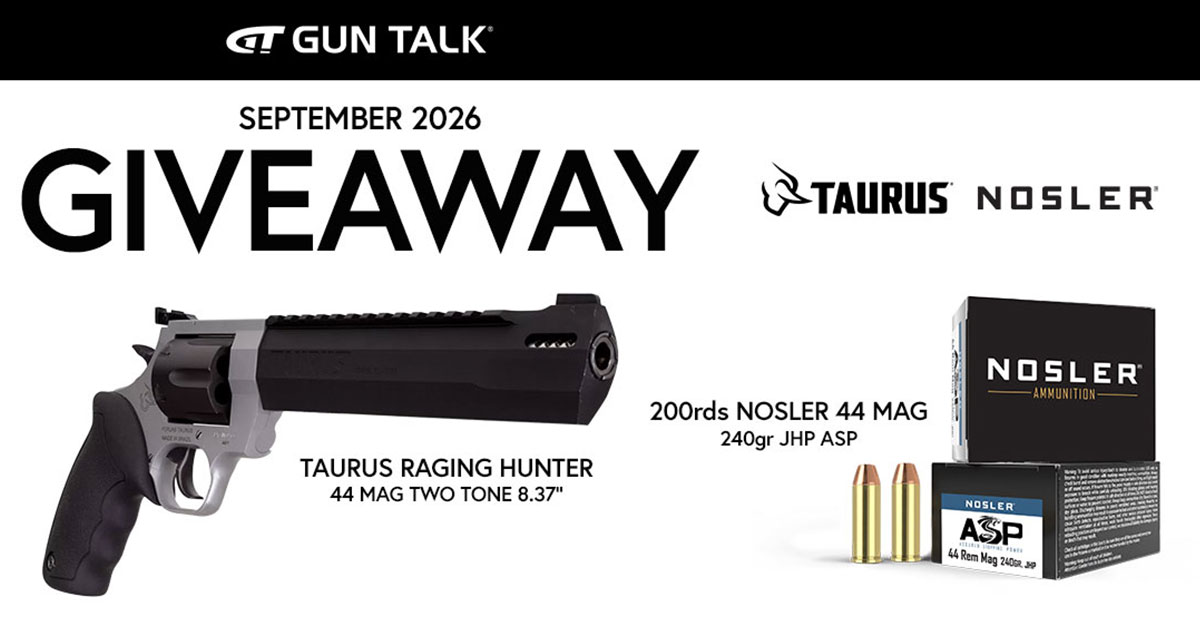
Gun Talk Giveaway
One lucky winner will bring home:
Open to U.S. residents 21+ only. Void where prohibited.